
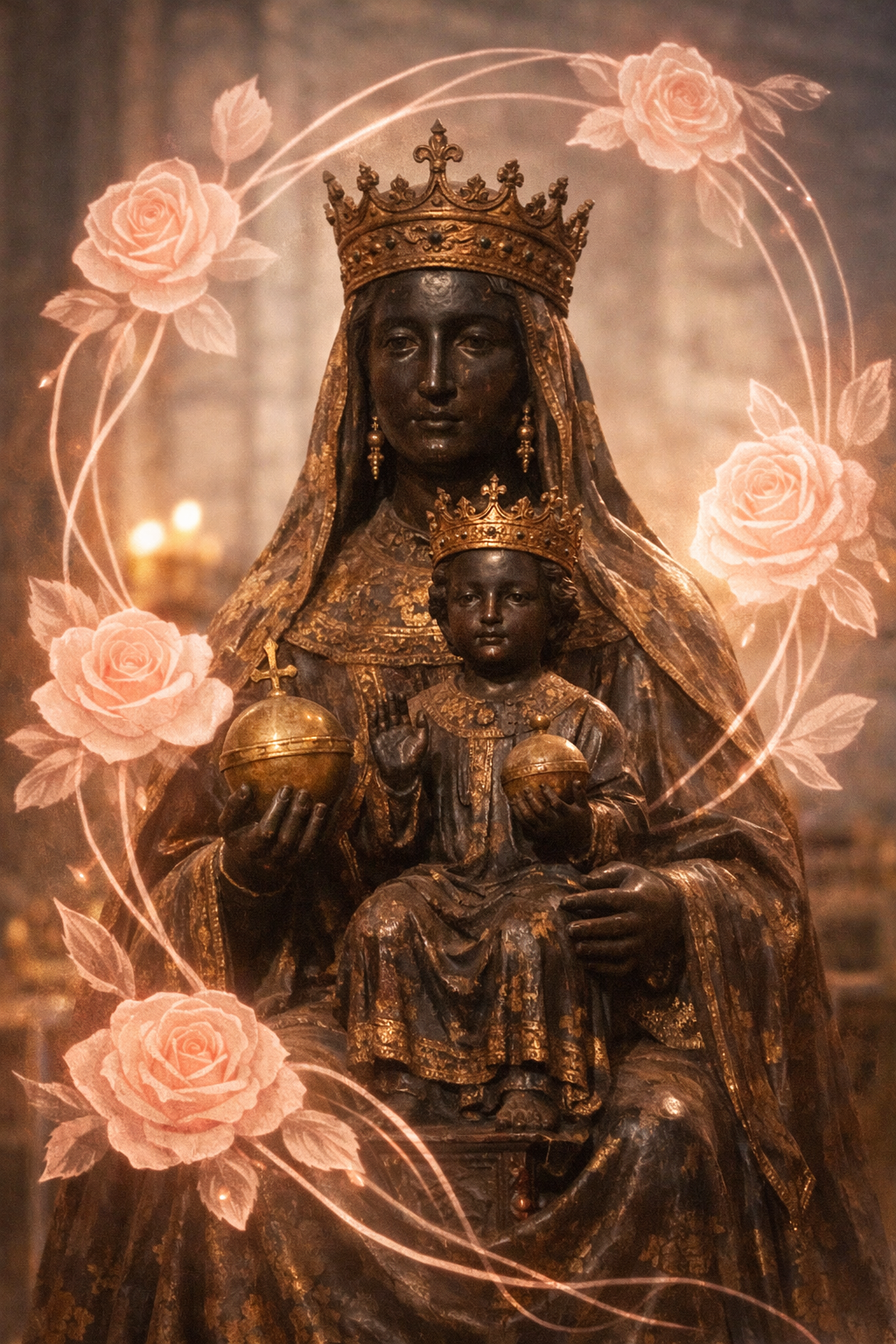
If you walk slowly through the villages of the Lot, something begins to appear again and again.
Above church doorways.
In shaded alcoves.
Carved into stone softened by centuries of weather and prayer.
A woman holding a child.
Sometimes she is pale, sometimes dark. Sometimes crowned, sometimes utterly simple. Often she stands at the threshold — neither fully inside nor outside — quietly watching those who pass.
At first, it feels familiar. Almost expected.
And then, if you linger long enough, it begins to feel ancient.
More Than Decoration, More Than Doctrine
In the Lot, these mother-and-child figures are not ornamental. They are not placed casually. They mark something important — a memory layered into the land itself.
Long before churches were built, before Christianity shaped the villages, this region held older stories. Stories of fertility, earth wisdom, cycles of birth and death, and the sustaining power of the feminine.
When Christianity arrived, it did not erase these images.
It absorbed them.
The goddess became the Madonna.
The child became Christ.
But the deeper symbol — woman as bearer of life, wisdom, and continuity — remained.
This is why these figures feel so present.
They are not relics. They are reminders.
The Body of the Earth, the Body of the Mother
The Lot itself feels unmistakably feminine.
Limestone cliffs shaped by water.
Caves, springs, and valleys.
A river that curves rather than cuts.
Sacred sites throughout history were often built where the land itself felt receptive — where the earth seemed to open, hold, and nourish. The Lot is filled with these places.
It is no coincidence that Marian shrines, Romanesque churches, and Black Madonna figures appear so frequently here. The symbol mirrors the land.
To be in the Lot is to feel held — not dramatically, but steadily. Quietly. As if the landscape itself understands the need for rest, gestation, and renewal.
The Black Madonna: Shadow, Soil, and Womb
Some of the most striking feminine figures in the region are the Black Madonnas — darkened by age, smoke, or deliberate design.
Their darkness has unsettled people for centuries. And yet, that darkness is precisely their power.
Black is the colour of:
- fertile soil
- night
- the womb
- mystery
- transformation
The Black Madonna does not promise rescue.
She promises presence.
In places like Rocamadour, pilgrims have sought her out not for easy answers, but for endurance — during childbirth, loss, storms at sea, and moments when life demanded surrender rather than control.
She reminds us that creation always includes darkness. That rebirth requires descent. That nothing living is ever purely light.
The Woman and the Child as Inner Landscape
What makes these images so powerful is that they do not only speak to belief — they speak to experience.
The woman and the child live within us.
They represent:
- the part of us that nurtures
- the part of us that protects
- the vulnerable, growing self that needs holding
- the wisdom that comes from embodiment rather than intellect
Many people — especially women — feel something stir when they encounter these figures. Sometimes tenderness. Sometimes grief. Sometimes a deep, wordless recognition.
It is not about motherhood in a literal sense.
It is about relationship with life itself.
Why These Symbols Still Matter Today
In modern life, the feminine has often been reduced to productivity, performance, or self-sacrifice. The deeper feminine — receptive, cyclical, intuitive — is rarely given space.
The villages of the Lot quietly resist this forgetting.
Here, time bends around meals.
Silence is not uncomfortable.
Rest is not earned — it is assumed.
The mother-and-child figures scattered throughout the region seem to echo this rhythm. They do not rush. They do not explain themselves. They simply remain.
And in doing so, they offer permission.
The Sacred Feminine and Retreat Work
This is why the Lot is such a potent setting for retreat work.
Transformation does not always happen through effort or insight. Often, it happens when something in us feels safe enough to soften.
The Sacred Feminine creates that safety.
Not by pushing us forward —
but by holding us while we unfold.
In villages near Puy-l’Évêque, these symbols are part of everyday life. They are passed without fanfare, yet they quietly shape the atmosphere. Guests may not consciously notice every statue — but their nervous systems do.
Something settles.
Something remembers.
An Invitation to Notice
If you find yourself walking through the Lot, pause when you see her.
The woman.
The child.
The threshold where they stand.
You don’t need to interpret.
You don’t need to believe.
Simply notice what stirs.
Because these images are not asking to be understood.
They are asking to be remembered.
And perhaps, through them, something ancient and essential in you is remembering itself too.




Leave a Reply
You must be logged in to post a comment.