
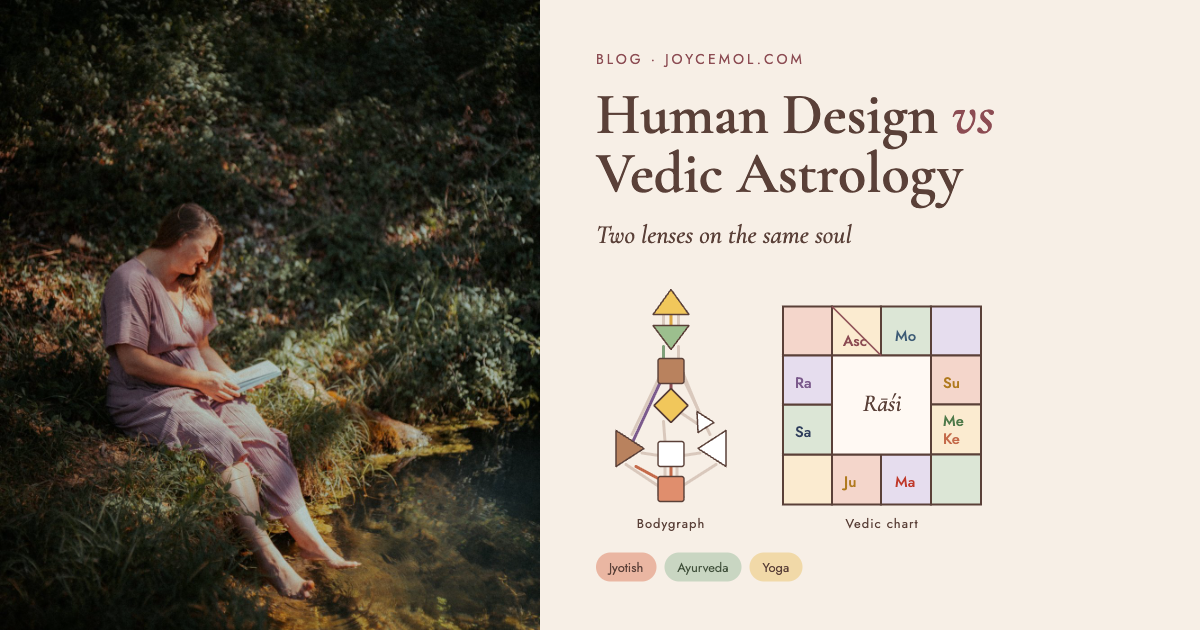
Maybe Human Design found you first. You know your type, your profile and your authority, and it gave you words for something you always felt. Then you hear about Vedic astrology, Jyotish, and you wonder: isn’t this the same thing? Human Design brings so many ancient wisdoms together, astrology included. So what is the difference?
It is a question I hear often, and it is a beautiful one. Let me share how I see it, as a Vedic astrologer and as a woman who lives her Human Design every day.
I am a 2/4 Projector. Projectors are here to guide, not to push. We see others deeply, and our energy flows best when we are recognised and invited in. That is exactly how my work is shaped: through 1:1 readings, mentorship and small circles, never through hustle. The Hermit line in me needs silence and time alone, so my work ripens in the dark before I share it. The Opportunist line means everything grows through connection, through the women who find me and the people who pass my name along.
Human Design gave me words for that rhythm. But it was Jyotish that brought everything home: my body, my yoga practice, my health and my soul path. Let me show you why.
What is Human Design?
Human Design is a young system. It was received and shared by Ra Uru Hu in 1987, and it weaves several older traditions into one map: Western astrology, the I Ching, the Kabbalah Tree of Life and the chakra system, combined with ideas from modern physics.
Your chart, called a bodygraph, is calculated from two moments. The first is the moment you were born. The second is roughly 88 days earlier, when the Sun stood 88 degrees before its birth position. Together they show nine energy centres, the gates and channels that connect them, and your type, strategy, authority and profile.
What I love about Human Design is how practical it is. It gives you a kind of user manual for your energy. How do you make decisions? Do you wait for an invitation, or respond, or initiate? Where are you open and easily influenced by others? For many women, this is the first time they feel permission to stop pushing and start trusting their own rhythm.
What is Vedic astrology (Jyotish)?
Jyotish means “the science of light”. It is one of the six Vedangas, the limbs that support the Vedas, and it has been practised in India for thousands of years. Not a modern blend. It is a living lineage, passed from teacher to student, with its own language, its own texts and its own way of seeing the soul.
A Vedic birth chart shows the sky at the exact moment you took your first breath. From there it speaks about your dharma (your purpose), your karma (the lessons your soul carries), your gifts, your relationships, your body and the timing of your life.
Five key differences between Human Design and your Vedic chart
1. A different zodiac
This is the difference that surprises most people. Human Design uses the tropical zodiac, the same one Western astrology uses. It is based on the seasons: 0 degrees Aries is always the spring equinox.
Jyotish uses the sidereal zodiac, which follows the actual position of the constellations in the sky. Because of the slow wobble of the Earth’s axis, the two zodiacs have drifted about 24 degrees apart. That means your Sun, Moon and other planets will often fall in a different sign in your Vedic chart. Many women who have always felt “not quite” like their Western Sun sign suddenly recognise themselves in their sidereal one.
2. A different question
Human Design mainly asks: how does your energy work? It describes your mechanics. How you are designed to make decisions, interact and use your energy without burning out.
Jyotish asks: why are you here, and what is your soul learning? It looks at your dharma and karma, at what you came to give and what you came to heal. It also gives a beautiful layer through the Atmakaraka, your soul planet, which shows the deepest longing of your soul in this life.
3. Time and cycles
Your bodygraph stays the same throughout your life. That is part of its strength: a steady blueprint to come back to.
Jyotish is deeply cyclical. Through the dasha system, your life unfolds in planetary periods that can last from a few years to two decades, each with its own themes. Add the transits, and your chart becomes a living calendar. You can see which chapter of your life you are in right now, and which season is coming.
To me, this feels so feminine. Like learning to read the seasons of your own life, the way we learn to read our cycle and the moon.
4. The Moon and the nakshatras
In Western astrology and Human Design, the Sun often takes centre stage. In Jyotish, the Moon is at least as important. She represents your mind, your emotions, your inner world and how you feel safe.
Vedic astrology divides the sky into 27 nakshatras, lunar mansions, each with its own deity, symbol and quality. Your Moon nakshatra reveals such tender, refined details about your emotional nature. It is often the part of a reading where women feel most deeply seen.
5. Roots and lineage
Human Design is a synthesis, a bridge between many traditions, created in our modern times. That is part of its accessibility.
Jyotish is one unbroken stream. It grew from the same source as yoga and Ayurveda, and that shared root is exactly where the magic happens for me.
Human Design and Jyotish side by side
| Human Design | Vedic astrology (Jyotish) | |
|---|---|---|
| Origin | 1987, Ra Uru Hu | Thousands of years, Vedic tradition |
| Zodiac | Tropical | Sidereal (about 24 degrees shifted) |
| Core question | How does my energy work? | Why am I here, and in which chapter am I now? |
| Main tools | Type, strategy, authority, profile, centres | Houses, planets, nakshatras, dashas, transits |
| Time | A fixed blueprint | Living cycles and planetary periods |
| Connection to the body | Energy centres | Doshas, body regions, Ayurveda and yoga |
Why Jyotish brings everything together for me
Jyotish, Ayurveda and yoga are often called sister sciences. They come from the same Vedic source and speak the same language. When I first understood this, something in me settled. Suddenly my work as a yoga teacher, my love of the body and my astrology were no longer separate interests. They were one path.
In your Vedic chart, the planets are linked to the doshas, the three energetic qualities of Ayurveda. Saturn carries the airy, dry quality of vata. The Sun and Mars carry the fire of pitta. The Moon and Jupiter carry the softness and steadiness of kapha. Your ascendant and the planets around it say something about your constitution, your vitality and where your body asks for extra care. The houses even correspond to regions of the body, from the head in the first house to the feet in the twelfth.
This makes astrology so tangible. It doesn’t stay in the mind as an interesting insight. It moves into how you eat, breathe, move and rest. Which yoga practice nourishes you. Whether your body longs for warming, grounding Yin or for something more cooling. When to slow down, and which season of your life asks for more rest.
For me, that is health in the deepest sense. Not fixing yourself, but living in harmony with your own nature and with the cycles around you. Coming home to your body, again and again.
A Vedic chart is never a diagnosis, and it doesn’t replace your doctor or an Ayurvedic practitioner. It is a mirror that helps you listen more closely to what your body already knows.
How I use both in my own life
I don’t see Human Design and Jyotish as rivals. I see them as two lenses on the same soul.
As a 2/4 Projector, Human Design reminds me to wait for the invitation, to protect my energy and to honour the Hermit who needs to withdraw. It helps me in the here and now, in daily choices and in how I show up in my business.
Jyotish holds the bigger picture. It shows me my dharma, the chapter of life I am in and how my body wants to be cared for through this season. When I feel tired or out of balance, my chart often tells me why, and Ayurveda and yoga show me how to come back.
One helps me live from my energy. The other connects that energy to my body, my health and my soul path.
Can you use Human Design and Vedic astrology together?
Absolutely. Just be aware that they use different zodiacs, so don’t be confused if your signs don’t match. Let each system speak in its own language.
If Human Design has been your entry point, a Vedic birth chart can feel like the next layer. Deeper, more cyclical, more connected to your body. And if you already practise yoga or love Ayurveda, Jyotish may feel like coming home to a language you somehow always knew.
An invitation
Are you curious what your Vedic chart says about your dharma, your soul planet and the way your body wants to be held?
I offer a personal Birth Chart Reading and an Atmakaraka (Soul Planet) Reading. You receive your chart as a PDF, with an optional 60-minute live session where we explore it together, gently and in your own rhythm.
You are warmly invited.
Frequently asked questions
Is Human Design the same as astrology? No. Human Design uses astrological calculations, but combines them with the I Ching, the Kabbalah and the chakra system. The result is a different map with its own language.
Why are my signs different in my Vedic chart? Jyotish uses the sidereal zodiac, which is about 24 degrees shifted from the tropical zodiac used in Western astrology and Human Design. Most planets move back roughly one sign.
What is the link between Jyotish and Ayurveda? Both come from the Vedic tradition. In Jyotish, planets and houses are linked to the doshas and to regions of the body, which helps you see your constitution and what supports your health.
Do I need my exact birth time? Yes, for both systems. Your birth time determines your ascendant and houses in Jyotish, and your profile and centres in Human Design.



Leave a Reply
You must be logged in to post a comment.