
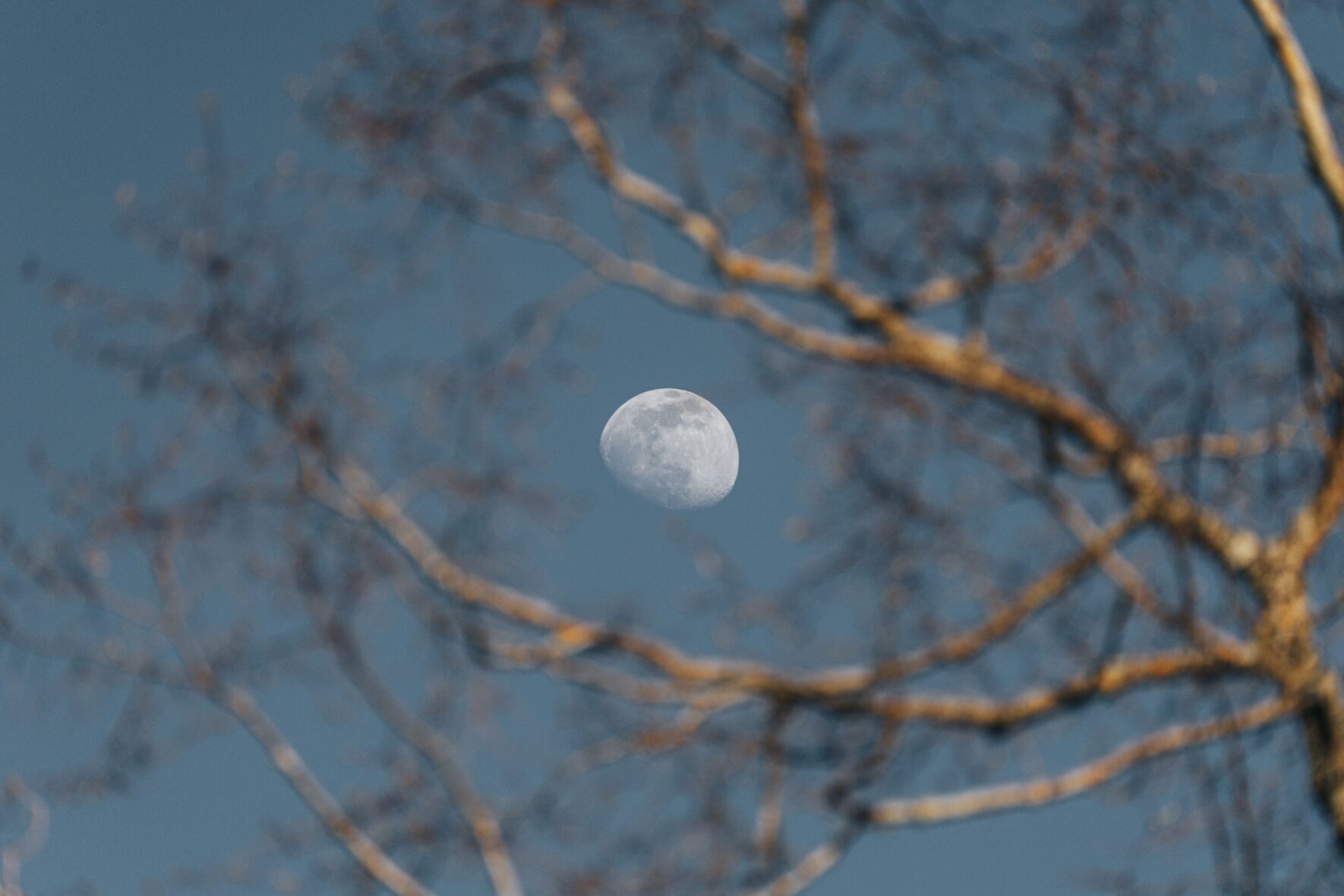
On Friday, 28 August 2026, the Moon reaches its fullest phase. This full moon coincides with a deep partial lunar eclipse: approximately 96 percent of the lunar disc will move through Earth’s dark central shadow. Across France and much of Western Europe, the eclipse reaches its peak in the early morning, shortly before the Moon sets.
In Vedic sidereal astrology, the Moon is in Kumbha (Aquarius) and the nakshatra Shatabhisha. Directly opposite, the Sun is in Simha (Leo), within Magha. Together they form an axis between the individual self and the collective, visibility and withdrawal, and inherited identity and renewal.
Within Vedic astrology, an eclipsed full moon is not simply a moment for manifestation. It is an invitation to slow down, observe and release what is no longer aligned with your inner truth.
When is the August 2026 full moon?
The astronomical full moon occurs on 28 August 2026 at approximately 4:18 a.m. UTC. This is around 6:18 a.m. in France, the Netherlands and other Central European Summer Time locations. The partial lunar eclipse reaches its maximum a few minutes earlier, at approximately 4:13 a.m. UTC.
NASA classifies this as a deep partial lunar eclipse. At maximum eclipse, 96.3 percent of the lunar disc will be within the umbra, Earth’s darkest shadow. The Moon may therefore appear largely dark red or copper-coloured. From Western Europe, it will be low on the western horizon, so visibility will depend on the weather and an unobstructed view.
A lunar eclipse is safe to observe with the naked eye. Unlike a solar eclipse, you do not need special eclipse glasses.
Why is the Moon in Aquarius in Vedic astrology?
Many Western astrology calendars place this full moon in Pisces. Vedic astrology generally uses the sidereal zodiac, which accounts for the position of the constellations in relation to Earth. Using the widely adopted Lahiri ayanamsha, the Moon falls in Aquarius.
The two systems use different reference points. In Jyotish, we also consider the nakshatra, the lunar nodes Rahu and Ketu, and the houses activated in your personal birth chart.
This personal dimension helps reveal where the full moon may be most meaningful for you. For one person it may illuminate relationships; for another, work, health, creativity or the need to belong.
Shatabhisha: the Hundred Healers
Shatabhisha is the twenty-fourth of the 27 nakshatras and lies entirely within Aquarius. Its name is often translated as “the Hundred Healers” or “the Hundred Medicines.” Its associated deity is Varuna, guardian of cosmic order, truth and the deep waters. Shatabhisha is ruled by Rahu, the north lunar node.
This nakshatra is associated with research, mystery, recovery and revealing what was previously concealed. Its symbol, an empty circle, can represent both protection and isolation. It asks: what belongs within your space, and what no longer does?
Themes of healing may feel more present under this full moon. This does not mean that everything can be resolved in a single lunar moment. Instead, it invites you to acknowledge honestly where care and attention are needed. Sometimes healing begins not by fixing yourself, but by no longer pretending that an old pattern still fits.
Rahu’s influence during this lunar eclipse
Astronomically, a lunar eclipse occurs when the Sun, Earth and Moon align. In Vedic astrology, eclipses are associated with Rahu and Ketu, the points where the paths of the Sun and Moon intersect.
Rahu amplifies, intensifies and obscures. It can awaken a strong desire for change, freedom, knowledge or a new identity. At the same time, it can make it harder to distinguish between a clear inner impulse and a reaction driven by restlessness.
Because the Moon symbolises our inner world, emotions and habits, a lunar eclipse may magnify what we feel. You may notice vivid dreams, inner unrest or sudden clarity about a pattern that is losing its hold. This is an astrological interpretation, not a prediction that everyone will experience the eclipse in the same way.
Try not to turn every emotion into an immediate life-changing decision. Write down what arises, sleep on it for a few nights and notice what still feels true afterwards.
The Sun in Magha: who are you without the old role?
Opposite the Moon, the Sun is in Leo and Magha nakshatra. In Vedic astrology, Magha is associated with ancestors, lineage, dignity, leadership and the place you occupy.
Shatabhisha calls for truth, renewal and the breaking of old systems. Magha reminds you of the lines you come from and the roles you may have inherited.
Around this full moon, you might ask yourself:
- Which role am I still carrying because it was once expected of me?
- Where do I keep myself outside the group to protect my freedom?
- Where do I adapt myself in order to belong?
- What form of healing requires honesty rather than control?
- What do I want to preserve from my lineage, and what may end with me?
This is not about rejecting your past. It is about consciously choosing what you want to carry forward.
From the solar eclipse to the lunar eclipse
This full moon closes an intense eclipse period that began with the solar eclipse of 12 August 2026. While a solar eclipse is often associated with a new beginning that is not yet fully visible, a lunar eclipse may bring something to an emotional culmination or completion.
Look back at what began moving around 12 August. What truth became visible? Where did you feel resistance or an unexpected opening? In Jyotish, eclipses are better understood as turning points than isolated moments you must comprehend within a single day.
A gentle ritual for this full moon
Traditionally, eclipses are considered times for stillness, meditation and mantra rather than elaborate manifestation rituals. You do not need to perform a complicated ceremony. Keep it simple and attuned to your body.
- Put your phone away and dim the lights.
- Sit quietly for a few minutes and feel the support beneath your body.
- Breathe without forcing and allow your exhale to become slightly longer.
- Write down what you no longer wish to carry.
- Ask: What truth does my body already know while my mind is still uncertain?
- Close with silence, meditation or a gentle mantra.
You do not need to find an answer during the eclipse. Let the ritual become a space in which you listen.
Yin Yoga for the full moon in Shatabhisha
Shatabhisha energy can feel mentally active and intense. A quiet Yin practice can guide your attention away from analysis and back into the body. Choose supported poses and keep the intensity low.
You might practise:
- Supported Child’s Pose for withdrawal and a sense of shelter;
- Butterfly with support beneath the knees and head;
- Reclined Twist to soften tension around the torso;
- Legs on a Chair to invite rest and grounding;
- several minutes of Savasana with one hand on your heart and one on your lower belly.
Stay in each pose for three to five minutes and come out slowly. You do not need to create a deep release. During an eclipse, gentleness may be more valuable than intensity.
In my Moon Phase Yin Yoga e-book, you will find practices created for the different phases of the Moon. The lunar cycle then becomes more than an abstract idea; it becomes a rhythm you can experience within your body.
What does this full moon mean for you personally?
A general moon reading describes collective symbolism. Your personal interpretation depends on your ascendant, Moon sign, nakshatra, planetary periods and the houses activated by the eclipse.
A Vedic birth chart reading reveals where Aquarius and Leo fall in your chart and which areas of life may be highlighted. A birth chart does not fix your future. It can help you understand recurring themes, natural qualities and directions for growth.
Would you like to learn how to interpret planets, houses, signs and nakshatras yourself? In my online Vedic Astrology course, I guide you step by step through the foundations of Jyotish so you can understand your own birth chart and transits with greater awareness.
Listen to what is becoming visible beneath the surface
The Vedic full moon of August 2026 in Shatabhisha carries themes of truth, healing, isolation and renewal. The deep lunar eclipse may make this moment feel more intense, but there is no need to fear it or force a transformation.
Let Shatabhisha’s empty circle become a quiet space. A space in which you do not have to know immediately what comes next, but can acknowledge what has reached completion. Sometimes a new direction emerges only when you stop holding on to the old one.
Would you like to explore this more deeply? Discover your Vedic birth chart, join the online Vedic Astrology course, or experience the lunar cycle through movement and stillness with the Moon Phase Yin Yoga e-book.
About Joyce Mol
Joyce Mol is a Vedic astrologer, yoga, breathwork and fascia therapy teacher, womb facilitator and author of Feminine Embodiment. Through Mind Events Factory, she guides women back into connection with their bodies, natural rhythms and inner wisdom. Her readings, online programmes and retreats weave together Vedic wisdom, Yin Yoga, breathwork, fascia and feminine embodiment.





Leave a Reply
You must be logged in to post a comment.