
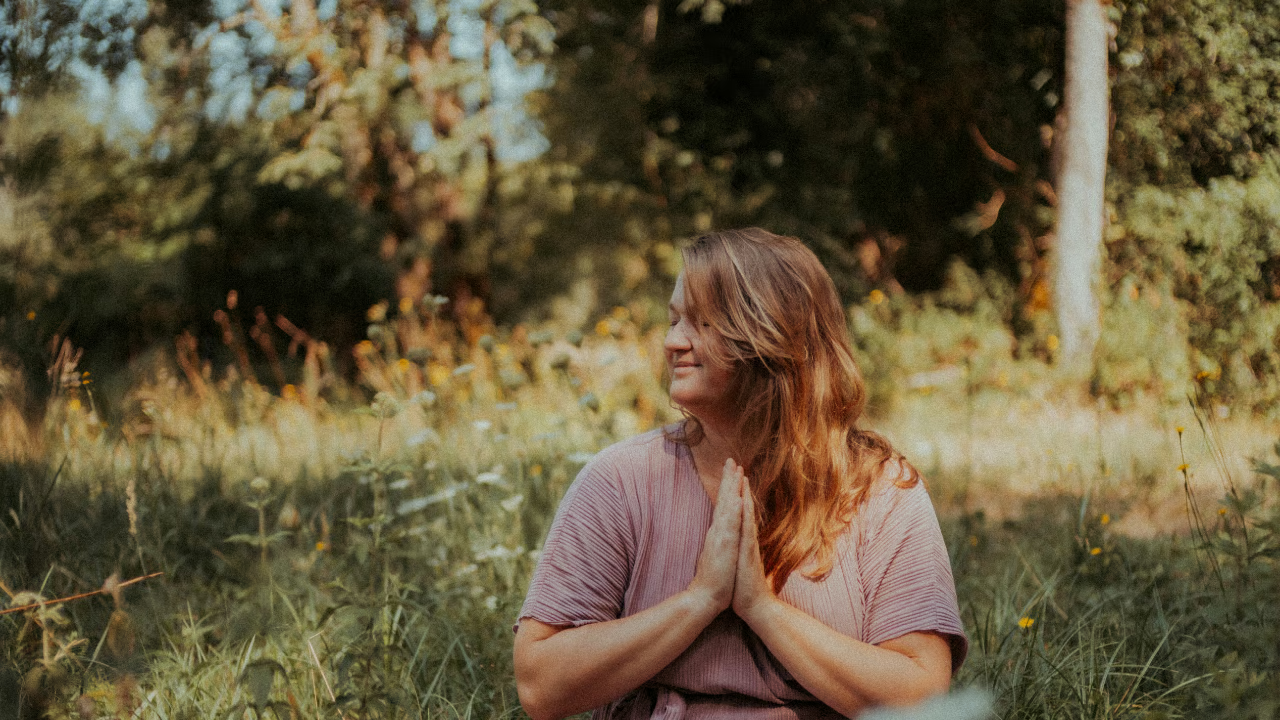
There is a moment I love in every practice. The moment the hands come together.
The breath slows. The shoulders soften. And something in me quietly says: I’m here now.
Mudras have been part of my yoga and meditation practice for years. Yet the longer I teach, the more I come back to their simplicity. You don’t need a mat, a studio or an hour of free time. You only need your hands, a few slow breaths and the willingness to pause.
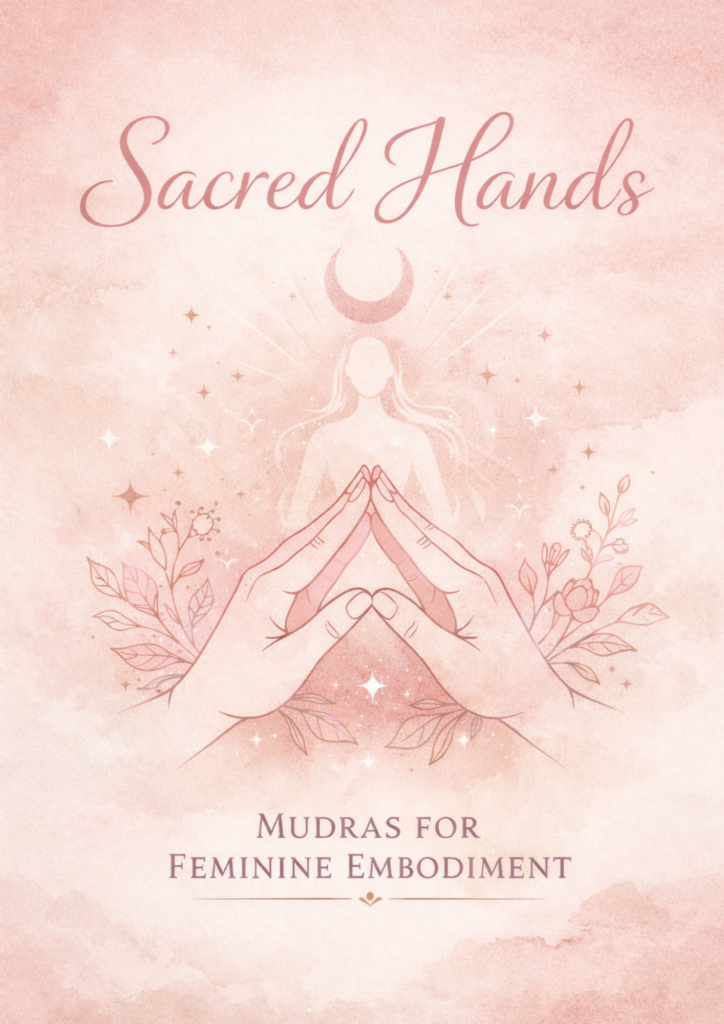
In this article you’ll learn what mudras are, where they come from, how to practice them, and 10 traditional mudras you can begin with today. And if you’d like to go deeper, you can download my free illustrated guide, Sacred Hands: 10 Mudras for Feminine Embodiment.
What are mudras?
A mudra is a symbolic gesture, most often made with the hands. The Sanskrit word mudra is usually translated as “seal”, “mark” or “gesture”.
Mudras appear across many Asian traditions. You’ll find them in Hindu and Buddhist ritual and iconography, in statues of the Buddha and of Hindu deities, and in Indian classical dance, where hand gestures help tell a story. In yoga, mudras are used alongside breath and meditation as a way to focus attention and set an intention.
It’s worth knowing that the word has more than one meaning in yoga. In classical hatha yoga texts, such as the Hatha Yoga Pradipika, “mudra” often refers to whole-body practices rather than hand positions. The hand mudras we use in yoga and meditation classes today draw on several of these streams together.
The meanings I share below are the traditional associations of each gesture. They are invitations for your practice, not medical treatments, and they don’t replace care from a health professional.
Mudras and feminine embodiment
So many of the women I work with live mostly in their heads. Planning, caring, holding, doing. The body becomes something that carries us from one task to the next, rather than a place we actually live in.
This is where mudras feel so precious to me. A mudra asks you to slow down enough to feel something: the touch of two fingertips, the warmth between your palms, the weight of your hands in your lap. That small act of sensing is already a return to the body.
In my book Feminine Embodiment, I write about softening, listening and coming home to the wisdom we carry in our bodies. Mudras are one of the gentlest doorways into that way of living. They are quiet, they are always available, and they ask nothing of you except presence.
I think of them as small anchors. Something you can return to, again and again, whenever life pulls you out of yourself.
How to practice a mudra
You don’t need any experience to begin. Here is a simple way to start:
- Find a comfortable seat. Sit on a cushion, a chair or your bed. Let your spine be long but not rigid.
- Arrive with your breath. Close your eyes or soften your gaze. Take three slow breaths and let the exhale be a little longer than the inhale.
- Form the mudra gently. Bring your fingers into the gesture with soft hands. The touch should be light, never forced.
- Rest your attention in your hands. Notice the contact, the temperature, any pulse or tingling. When your mind wanders, simply come back to the sensation.
- Stay for a few minutes. Three to five minutes is a lovely place to start. You can stay longer as it begins to feel natural.
- Release slowly. Let the hands rest and take a moment to notice how you feel before moving on.
You can combine a mudra with your meditation, your yin yoga practice, your breathwork, or simply a quiet pause in your day.
10 mudras for meditation and feminine embodiment
These are the 10 mudras I share in my free guide. Different lineages sometimes describe a gesture in slightly different ways, so see these as gentle starting points.
1. Gyan Mudra: the gesture of wisdom
How to form it: Touch the tip of your index finger to the tip of your thumb. Extend the other three fingers softly. Rest the backs of your hands on your knees, palms facing up.
Traditional meaning: Gyan (or jnana) means knowledge or wisdom. It’s one of the best-known mudras for meditation and is often used to support focus and receptivity.
2. Anjali Mudra: the gesture of offering
How to form it: Press your palms together in front of your heart, fingers pointing up.
Traditional meaning: Anjali means offering. This is the gesture that often accompanies the greeting namaste. It’s a gesture of respect, gratitude and coming back to center.
3. Hridaya Mudra: the gesture of the heart
How to form it: Fold your index finger to the base of your thumb. Bring the tips of your middle and ring fingers to the tip of your thumb. Extend your little finger.
Traditional meaning: Hridaya means heart. In yoga traditions this mudra is associated with the heart space, and many people use it for heart-centered meditation.
4. Yoni Mudra: the gesture of the womb
How to form it: Bring the tips of your thumbs together pointing up, and the tips of your index fingers together pointing down, forming a triangle. Interlace or fold the other fingers. Rest the hands in front of your lower belly.
Traditional meaning: Yoni means womb or source. This mudra is linked to the feminine, to creation and to turning inward. It’s a beautiful gesture for womb awareness and feminine embodiment practice.
5. Prithvi Mudra: the gesture of earth
How to form it: Touch the tip of your ring finger to the tip of your thumb. Extend the other fingers.
Traditional meaning: Prithvi means earth. Traditionally it is connected to the earth element, stability and grounding. It’s lovely when you feel scattered or far from your body.
6. Apana Mudra: the gesture of letting go
How to form it: Bring the tips of your middle and ring fingers to the tip of your thumb. Extend your index and little fingers.
Traditional meaning: In yogic philosophy, apana is the downward-moving energy linked to release and elimination. This mudra is traditionally associated with letting go.
7. Chin Mudra: the gesture of consciousness
How to form it: Form the same circle as Gyan Mudra, index fingertip touching thumb, but rest the hands with the palms facing down.
Traditional meaning: Chin is connected to chit, consciousness. With palms down, many teachers describe it as a more grounding, inward variation of Gyan Mudra. Some traditions reverse the two names.
8. Dhyana Mudra: the gesture of meditation
How to form it: Rest your hands in your lap, palms up, the right hand resting in the left. Let the tips of your thumbs touch lightly, forming an oval.
Traditional meaning: Dhyana means meditation. It’s the gesture often seen in seated Buddha statues and is used for stillness and contemplation.
9. Surya Mudra: the gesture of the sun
How to form it: Fold your ring finger toward the base of your thumb and rest your thumb gently over it. Extend the other fingers.
Traditional meaning: Surya means sun. Traditionally the mudra is connected to the fire element, warmth and vitality.
10. Varada Mudra: the gesture of giving
How to form it: Let one hand hang naturally by your side or rest it on your knee, palm open and facing forward, fingers pointing down.
Traditional meaning: Varada means granting or bestowing. Seen in many Buddhist and Hindu images, it’s the gesture of generosity, compassion and giving freely.
A small mudra ritual for your day
If you’re not sure where to begin, try this five-minute ritual in the morning or before sleep:
- Arrive with Anjali Mudra at your heart. Take three slow breaths and set a simple intention for your day.
- Ground with Prithvi Mudra. Feel the weight of your body and the support beneath you.
- Turn inward with Yoni Mudra resting in front of your lower belly. Breathe softly into your belly and simply notice.
- Rest in Dhyana Mudra for a few quiet breaths before you open your eyes.
That’s all. No perfection, no performance. Just a few minutes of being with yourself, through your hands.
Receive the free guide: Sacred Hands
If you’d like to keep these mudras close, I created a beautifully illustrated e-book for you: Sacred Hands: 10 Mudras for Feminine Embodiment.
Inside you’ll find:
- All 10 mudras, each with its own illustration
- How to form each gesture and its traditional meaning
- Simple embodiment cues to move out of the mind and back into the body
- Ideas for bringing the mudras into your meditation, yoga and daily rituals
It’s my gift to you, and you can download it here: Receive Sacred Hands for free.
Frequently asked questions about mudras
What does the word mudra mean?
Mudra is a Sanskrit word usually translated as “seal”, “mark” or “gesture”. In yoga and meditation it most often refers to symbolic hand gestures.
How long should I hold a mudra?
There is no fixed rule. Three to five minutes is a gentle place to begin, and you can stay longer as it feels comfortable. What matters most is that your hands stay soft and your attention stays with them.
Can beginners practice mudras?
Yes. Mudras are one of the most accessible practices in yoga. You can do them seated, lying down or even during a quiet pause at your desk.
Which mudra is best for meditation?
Gyan Mudra and Dhyana Mudra are two of the most commonly used mudras for meditation. Try both and notice which one helps you settle.
Which mudra is connected to feminine energy?
Yoni Mudra is traditionally linked to the womb, the feminine and the source of creation. It’s a lovely mudra for womb awareness and feminine embodiment practices.
Do mudras have proven health effects?
The meanings of mudras come from tradition and lived practice, not from medical research. I invite you to use them as tools for presence, intention and embodiment, and to see a health professional for any medical concerns.
With love, Joyce
Want all 10 mudras beautifully illustrated in one place? Download Sacred Hands for free.





Leave a Reply
You must be logged in to post a comment.